← Insights
Owning Retail Property in Florida: Net Leases, Strip Centers and Grocery Anchors
How retail property earns its income, the formats on the market, what South Florida numbers look like today, and what we check before a client buys.

How retail property earns its income, the formats on the market, what South Florida numbers look like today, and what we check before a client buys.
Retail is the commercial property type most investors understand intuitively. You can drive past it, walk into it and see whether people are spending money there. In Florida it has also been one of the steadiest: population growth, tourism and very little new construction have kept shop space full for years. That familiarity is useful, but it can also make buyers less careful than they should be. This guide covers how retail property actually earns its income, the formats you will see on the market, what the numbers look like in South Florida today, and what we check before a client buys.
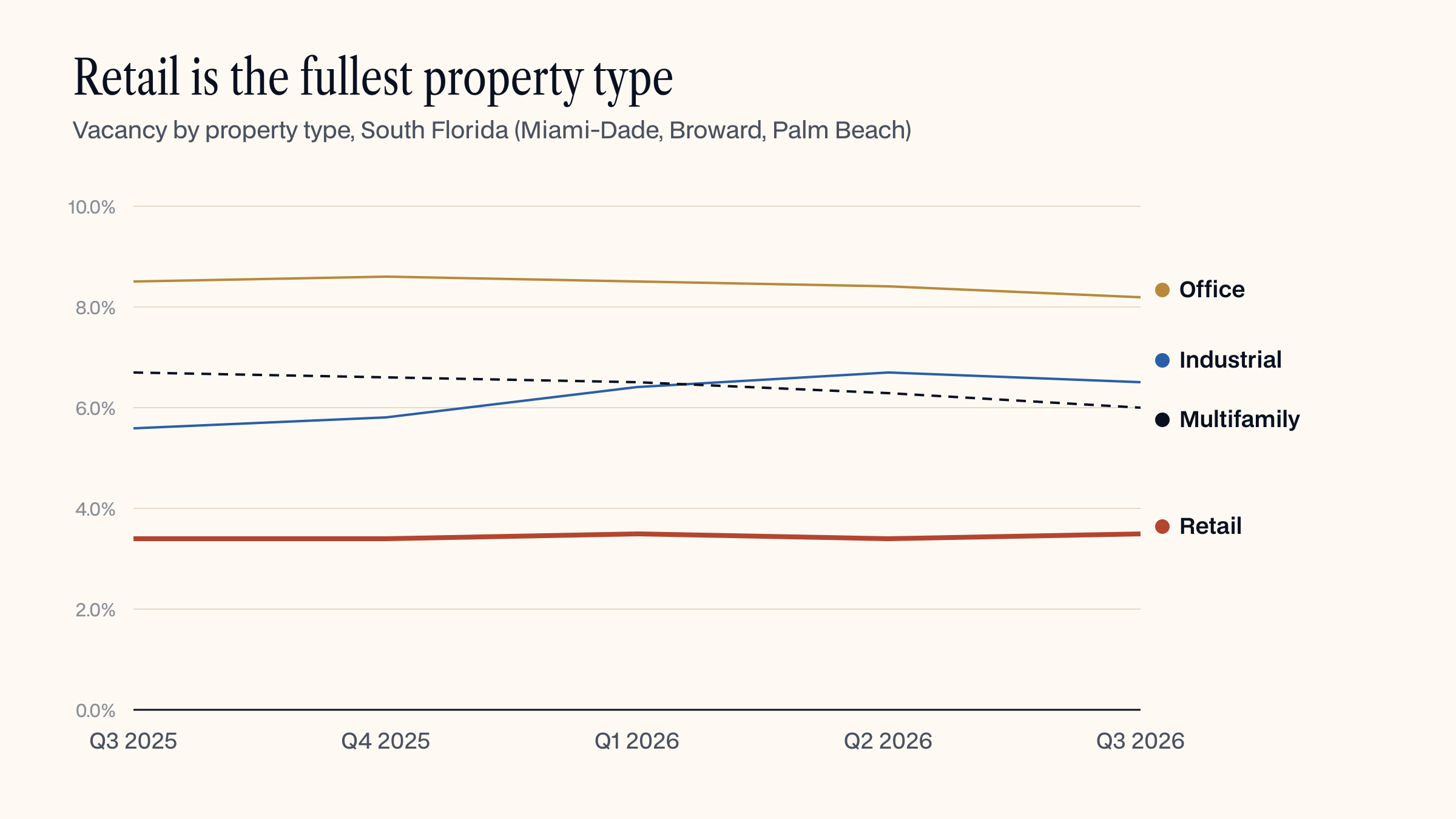
The case for Florida retail rests on a simple imbalance: more people arriving every year, and very little new shop space being built for them. In Miami-Dade, retail vacancy was about 3.1% in the third quarter of 2026 according to CoStar data published by Matthews, and Lee & Associates reports a tri-county figure of 3.5%. Retail vacancy that low means a landlord who loses a tenant in a good location can usually replace it.
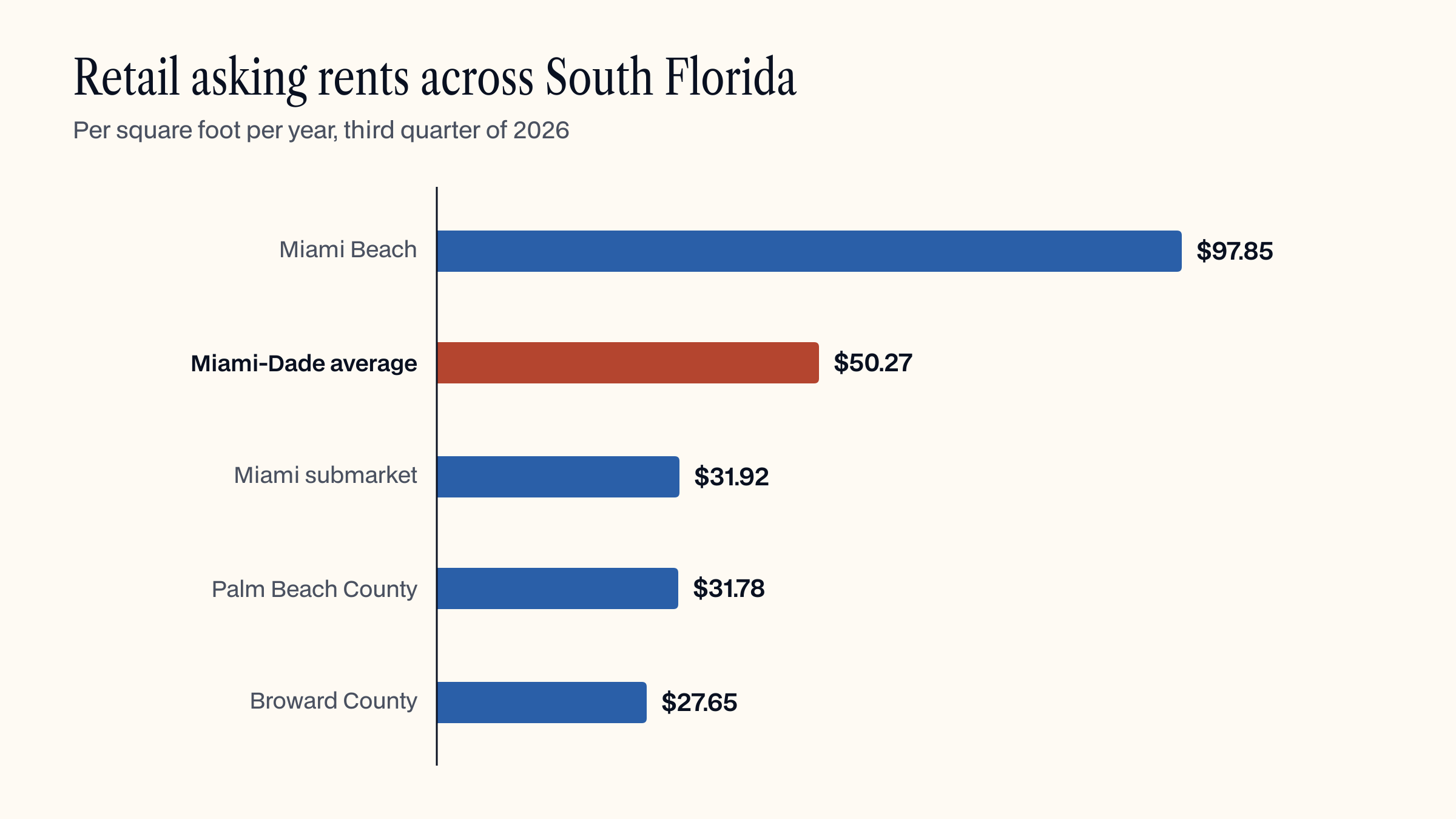
Rents have followed. Cushman & Wakefield reports an average retail asking rent in Miami-Dade of $50.27 per square foot in the third quarter of 2026, up 1.8% over the year, with a very wide range between submarkets: Miami Beach averages close to $98, while the lowest-priced submarket averages under $32. Palm Beach and Broward are lower and growing, with Palm Beach County posting about 10.9% annual rent growth.
Low vacancy tells you that the market as a whole is healthy. Whether a particular center is healthy depends on its tenants, its location and its leases.
Retail property comes in a few distinct formats. They differ in who the tenants are, how long the leases run, how much work the owner does and how the market prices the income.
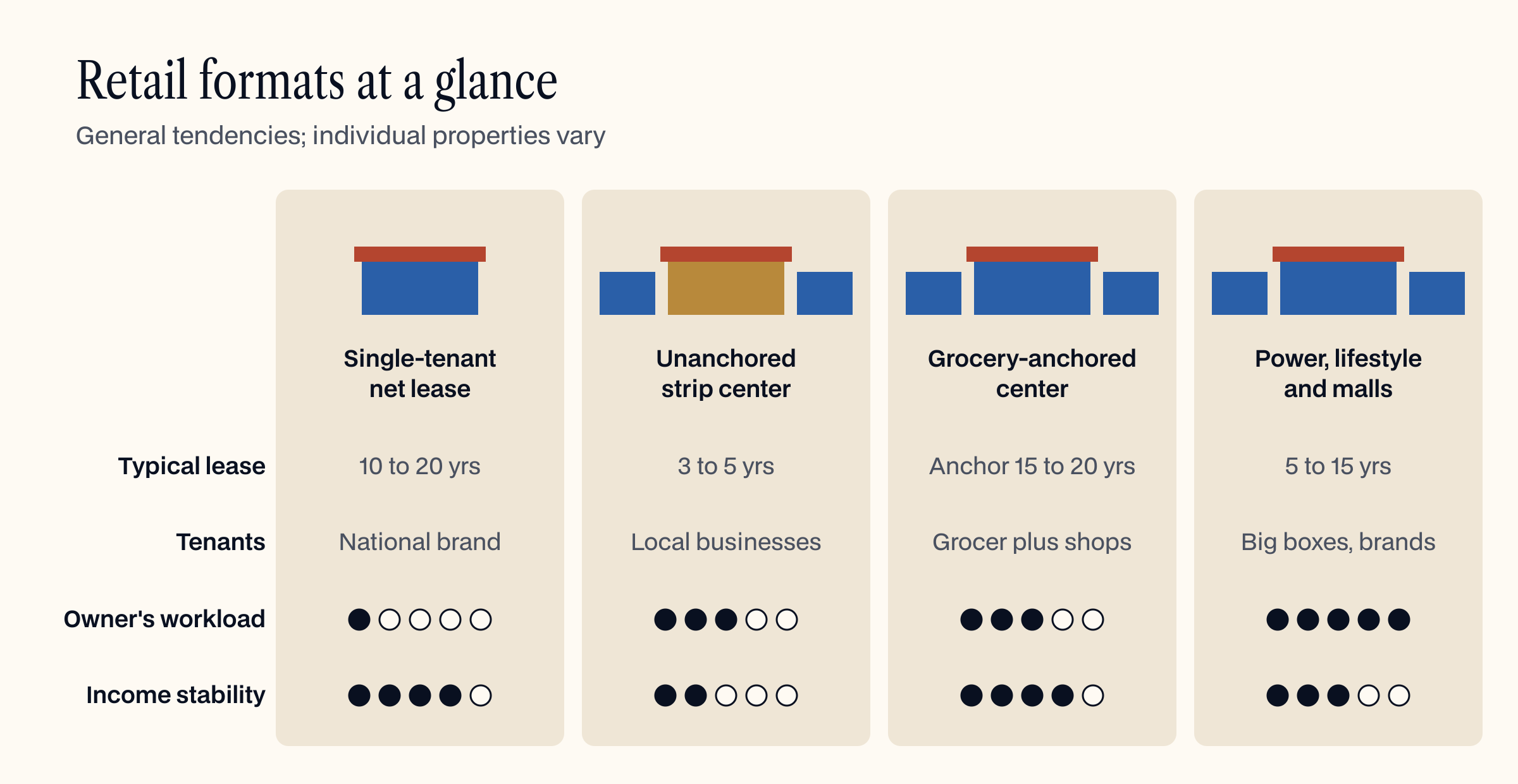
Single-tenant net lease (NNN). One building, one tenant, usually a national or regional brand: a pharmacy, a quick-service restaurant, a bank branch, an auto parts store, a dollar store. The tenant typically pays rent plus taxes, insurance and maintenance under a long lease of 10 to 20 years. The owner's work is minimal, and the value depends almost entirely on the strength of the tenant and the terms of the lease. This is the format we see international buyers ask about most often, and the one Valentina's practice focuses on.
Unanchored strip center. A row of smaller shops along a busy road, with tenants such as nail salons, dry cleaners, local restaurants and medical offices. Leases are shorter, often three to five years, and tenants are mostly local businesses. Returns are usually higher, and so is the work: more leases to renew, more turnover, more management.
Grocery-anchored center. A neighborhood center built around a supermarket, with smaller shops around it that benefit from the daily traffic the grocer brings. In Florida, Publix anchors a large share of these. Grocery-anchored centers are among the most sought-after retail investments because people buy food in person regardless of the economy.
Larger formats. Power centers with big-box tenants, lifestyle centers and malls are usually owned by institutions and funds. They are rarely the right first purchase for a private investor.
In a typical Florida retail lease the tenant pays base rent plus its share of the property's operating costs, which brokers call CAM (common area maintenance), taxes and insurance. These are recovered from tenants each month on an estimate and reconciled once a year. When the lease is truly triple net, rising insurance and taxes are passed through to the tenant rather than coming out of the owner's income.
Two details in the lease decide much of the investment's long-term return.
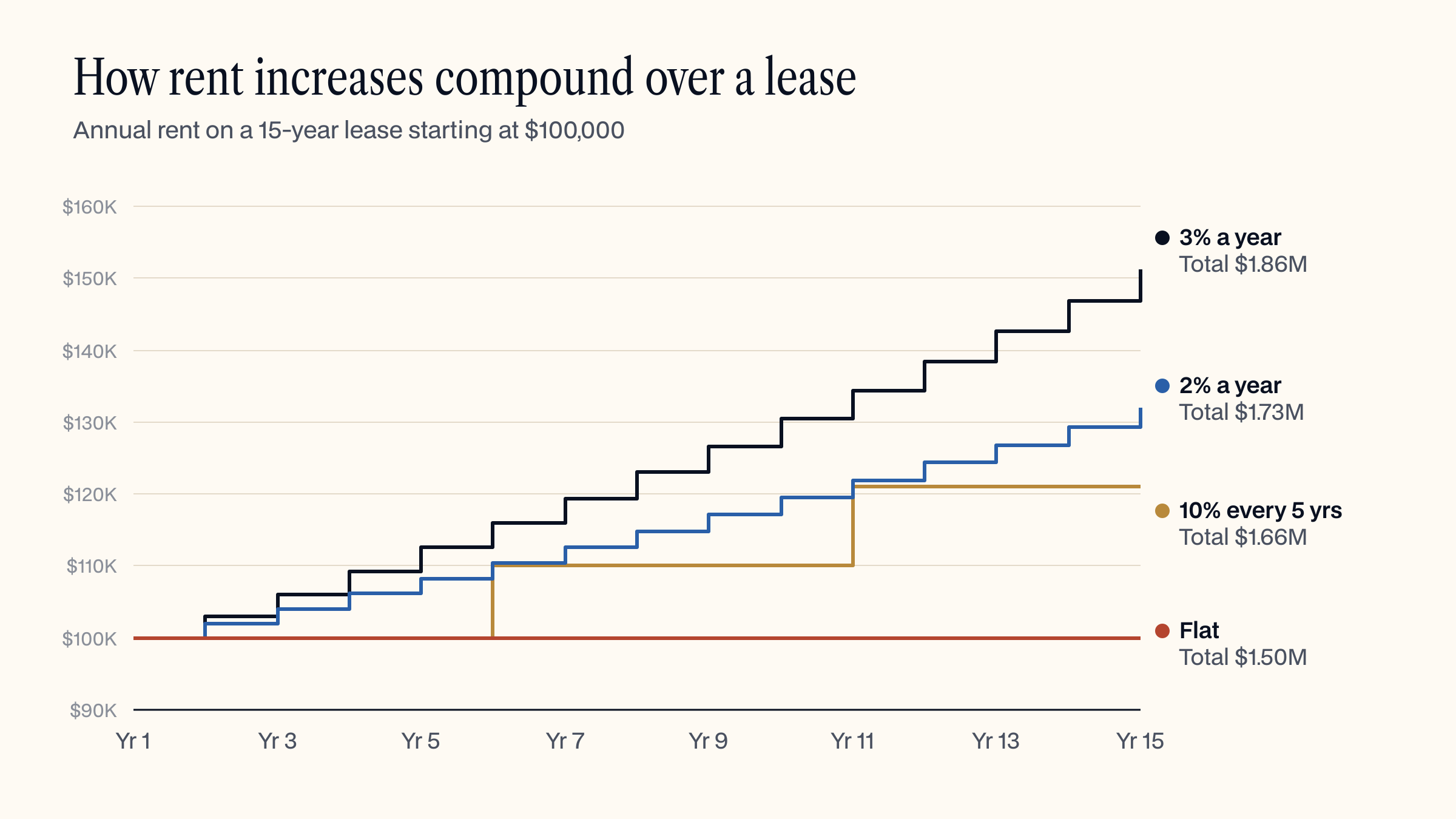
How rent increases. Some leases increase rent by a fixed percentage every year. Others, especially long single-tenant leases with national brands, keep rent flat for five years and then raise it by 10%. Over a long lease the difference compounds. Flat rent with no increases for ten or fifteen years is the most common hidden weakness we find in net lease properties offered to foreign buyers, because the cap rate looks attractive on day one and loses ground to inflation every year after.
Who is actually responsible. A listing may call a lease triple net, but only the lease itself says what the tenant covers. Read who pays for the roof, the parking lot, the structure and the HVAC. In some leases the landlord keeps those obligations, and a new roof on a retail building can cost more than a year of rent.
Single-tenant net lease properties are priced mostly on two things: the credit of the tenant and the years left on the lease. A store leased to an investment-grade national company with 15 years remaining will sell at a lower cap rate, meaning a higher price, than the same building leased to a franchisee with four years left. For context, Miami retail as a whole averaged a 6.00% cap rate in the third quarter of 2026 according to CoStar data published by Matthews, with prices at a record of about $511 per square foot.
It is worth understanding who stands behind the lease. A lease signed by a corporate parent is backed by that company's balance sheet. A lease signed by a local franchisee of the same brand is backed only by that franchisee, even though the sign on the building looks identical. The difference in risk is large, and it should show up in the price.
| Area | What we look at |
|---|---|
| Tenant | Who signed and who guarantees the lease, the tenant's financial strength, and store sales where reported |
| Lease | Remaining term, renewal options, rent increases, landlord responsibilities, early termination rights |
| Rent | Rent compared with market, and rent as a share of the store's sales where available |
| Site | Traffic counts, visibility, access, parking, and the population and income within a short drive |
| Building | Roof age, HVAC, parking lot, ADA compliance, flood zone and insurance quote |
| Exit | Who would buy this property in five or ten years, and at what remaining lease term |
For an investor who wants predictable income and little day-to-day management, a well-located single-tenant net lease property with a strong tenant and rent growth built into the lease is one of the simplest ways to own commercial real estate in Florida. For an investor willing to manage more in exchange for a higher yield, a multi-tenant strip or neighborhood center offers more control and more ways to add value.
In both cases, the questions are the same ones we ask of every building: whether the income is real, whether it will grow, and whether you are paying a fair price for it. Our complete guide to owning commercial real estate in Florida covers financing, taxes and the purchase process in more detail.
This guide is general information and is not legal, tax or investment advice. Market figures are from the sources cited and change every quarter. Valentina Ashrafi is a Florida-licensed real estate agent with LRF Group, a Berkshire Hathaway HomeServices affiliate.
Ahmad Ashrafi is Founder and CEO of Infinity⁹ in Miami and Chief Investment Officer of A9 Family Office. Since 2012 he has managed capital for Latin American families, today more than 75 families across 10 countries. He studied at Babson College, with specializations at Harvard in family office wealth management and at MIT in real estate investment, and is a member of the Forbes Finance Council.
Guides, conversations and the Quarterly Report, in your language. Nothing else.

Infinity⁹ is the commercial name of Infinity Investment Group LLC ("Infinity"), the parent holding company. Investment management is carried out by Infinity Capital Asset Management, LLC, an exempt reporting adviser (CRD 330526), for accredited international investors and high-net-worth individuals. Neither is a broker-dealer or a member of FINRA. Exempt reporting status does not imply a particular level of skill or training.
Past performance is not indicative of future results. Historical returns, expected returns and probability projections are speculative. All investment involves significant risk, including the possible total loss of capital. Infinity does not guarantee that investment objectives will be met.
Nothing here is an offer to sell or a solicitation of an offer to buy any security, nor investment, legal or tax advice. Any offering is made solely through definitive subscription documents under Regulation D of the Securities Act of 1933. Consult your own advisors.
Commercial brokerage operates through a licensed Florida agent with LRF Group at Berkshire Hathaway HomeServices, separately from investment management, under distinct regulatory oversight. Banking and custody are provided by partner institutions.