← Insights
How to Own Commercial Real Estate in Florida: A Complete Guide
How commercial property earns its income, how it is valued and financed, what owning in Florida costs, and the questions we ask before recommending a building.

How commercial property earns its income, how it is valued and financed, what owning in Florida costs, and the questions we ask before recommending a building.
Owning a commercial building in Florida means owning a stream of rent paid by businesses. Everything else follows from that. The value of the property, the loan a bank will give you, the tax you pay and the price you will get when you sell are all measured against the income the building produces, and against how reliable that income is.
This guide explains how that works in practice for someone buying their first or their tenth commercial property in Florida: the main property types, how leases decide who pays for what, how income becomes value, how financing is sized, what it costs to own here in particular, and the questions we ask before recommending that a client buy anything. It is written for investors, including buyers who live outside the United States.
Most commercial real estate in Florida falls into four families. Each has its own tenants, its own lease customs and its own risks, and each is priced differently by the market.
| Retail | Industrial and flex | Office and medical office | Multifamily (5+ units) | |
|---|---|---|---|---|
| Who pays you | Shops, restaurants, banks, pharmacies, service businesses | Distributors, contractors, light manufacturers, last-mile operators | Professional firms, doctors, clinics, corporate tenants | Households |
| Typical lease length | 5 to 20 years | 3 to 10 years | 5 to 10 years | 12 months |
| Usual lease structure | Triple net | Triple net | Full service or modified gross | Gross (owner pays most costs) |
| Management intensity | Low to moderate | Low | High | High |
| What usually goes wrong | A tenant's business fails | Too much new supply nearby | Vacancy and the cost of re-leasing | Expenses rise faster than rent |
We have written a separate guide on each of these. This one covers what they share.
A commercial property is valued by its net operating income, or NOI: the rent it collects, minus vacancy and minus the operating costs the owner pays, before any loan payments or income tax. NOI is the number that every buyer, appraiser and lender looks at first.
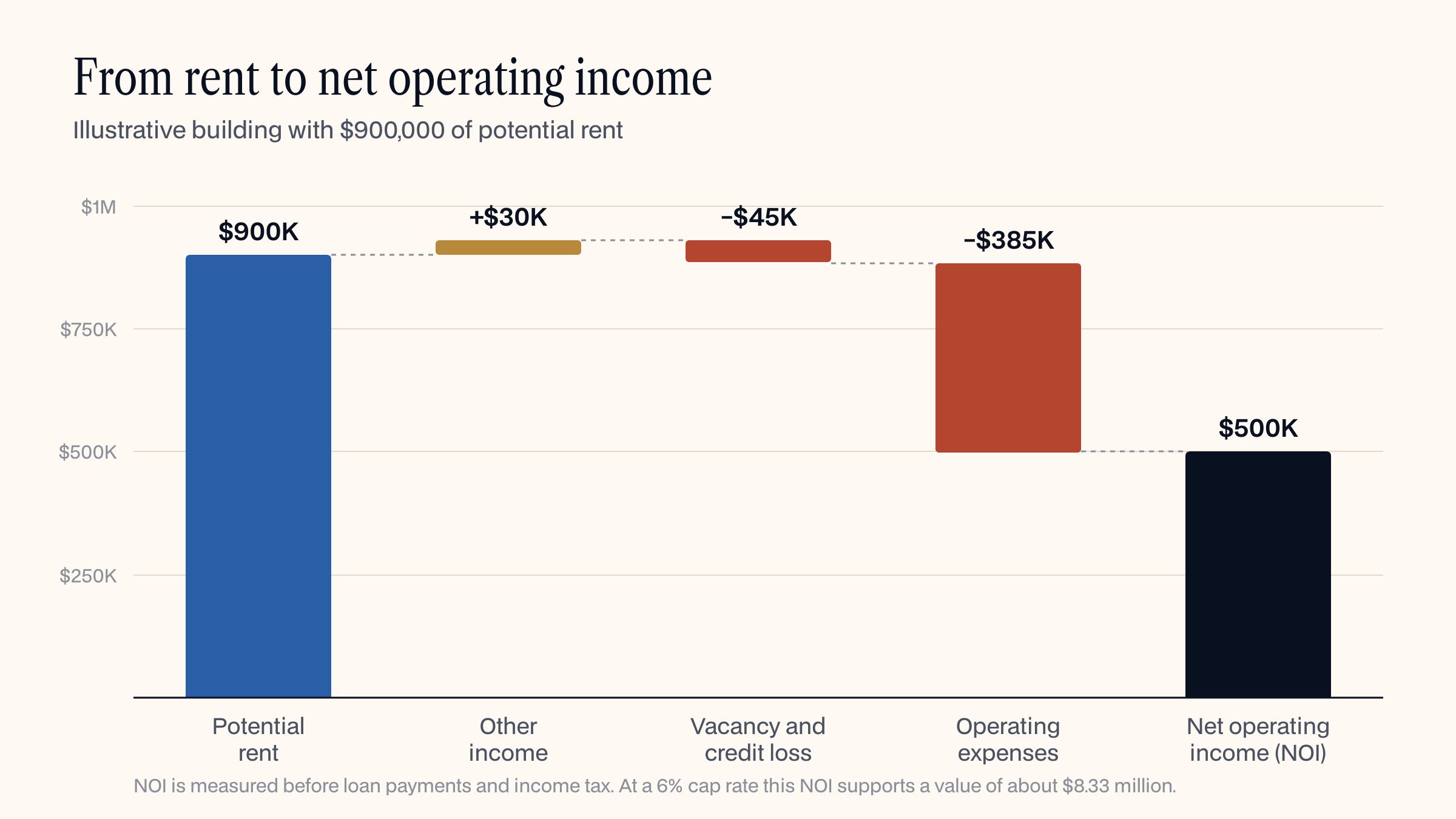
The market then converts NOI into a price through the capitalization rate, or cap rate. The cap rate is simply NOI divided by price. A building producing $500,000 of NOI that sells for $8.33 million traded at a 6% cap rate. Turned around, if buyers for that kind of building in that location are paying around 6%, the building is worth roughly $500,000 divided by 0.06.
Two things follow from this. The first is that every dollar of income you add or protect is worth many dollars of value. At a 6% cap rate, one extra dollar of NOI is worth about $16.67 of price. The second is that small moves in the cap rate move value a great deal, which is why the price you pay matters as much as the income you buy.
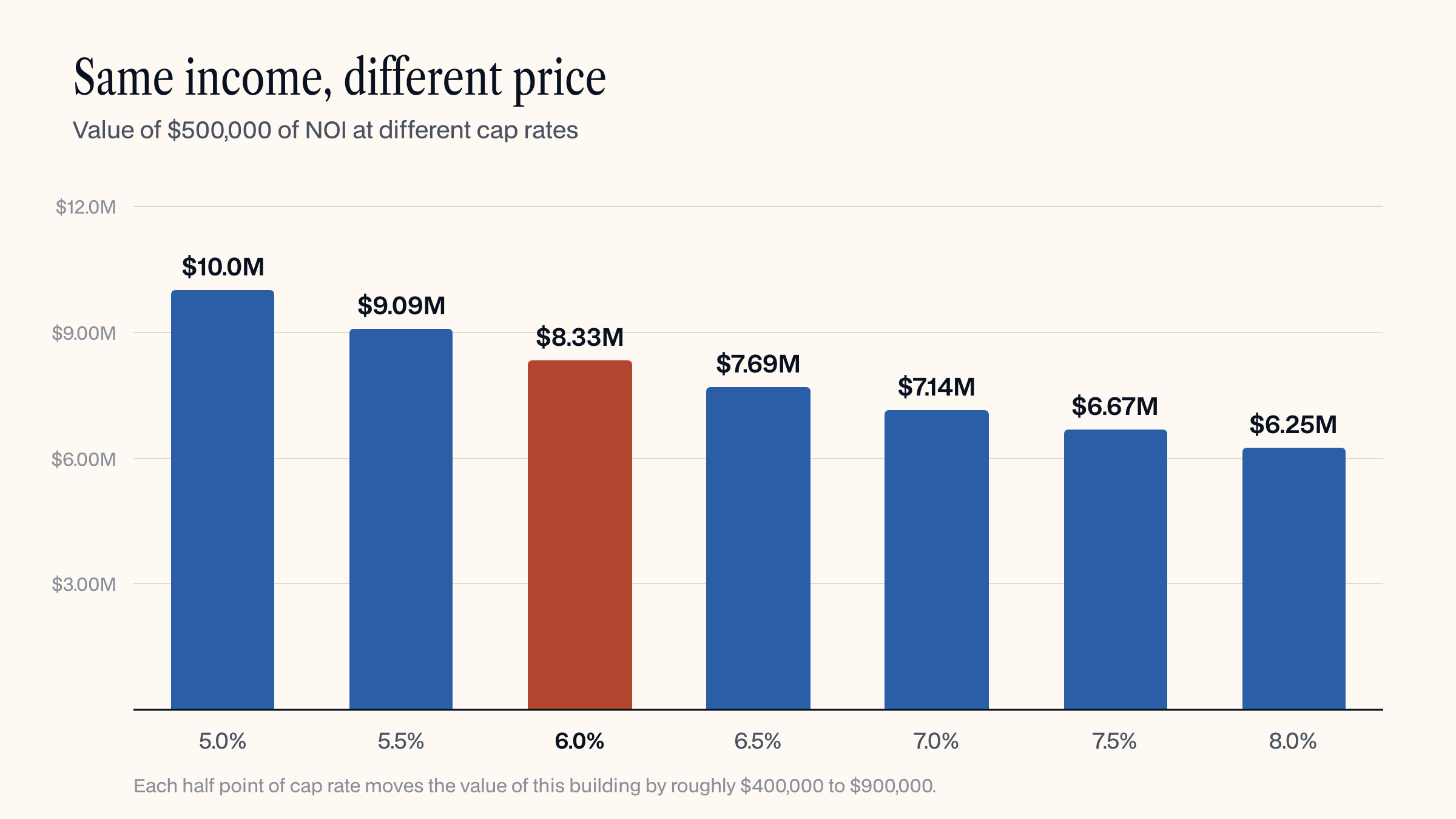
At Infinity⁹ we say it simply: your cost is where you win. Most of the return on a commercial property is decided on the day you buy it, by the cap rate you buy at relative to the income that is truly there. You cannot fix an expensive purchase with good management later.
Cap rates differ by property type because the market prices the risk and the growth of each income stream differently. In Miami, the latest CoStar-based figures published by Matthews put the average cap rate at 6.00% for retail, 5.53% for industrial and 5.43% for multifamily in the third quarter of 2026. Office trades higher. Lee & Associates reports a 7.17% average office cap rate for South Florida in the same quarter.
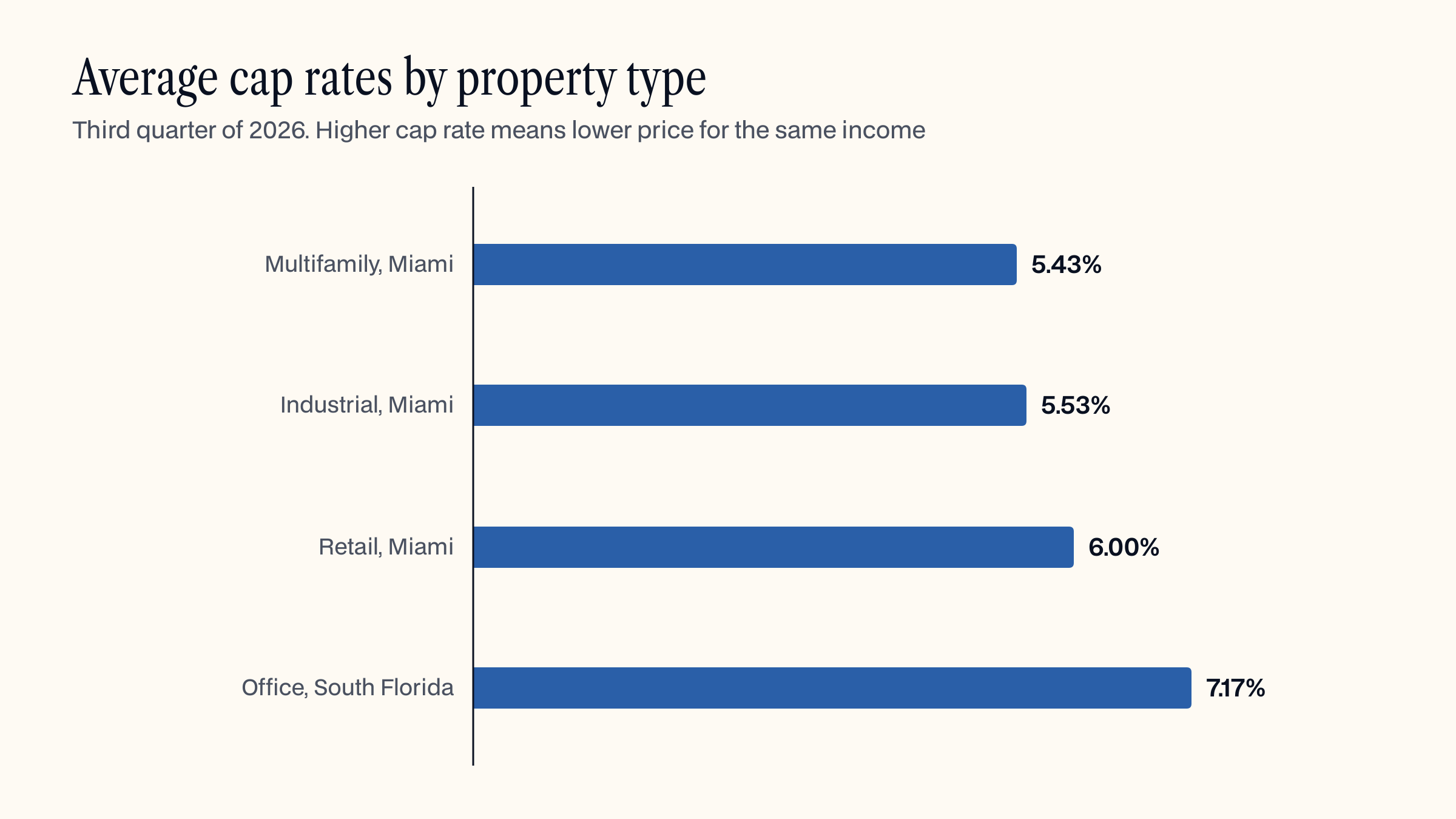
These are averages across many very different buildings. A new grocery-anchored center and a tired strip of local shops can both be called "retail" and still trade two full points apart. Averages tell you where the market is; the value of a specific building comes from its leases, its location and its condition.
In a home rental, the owner pays the property tax, the insurance and the repairs. In commercial real estate, the lease decides, and the differences are large.
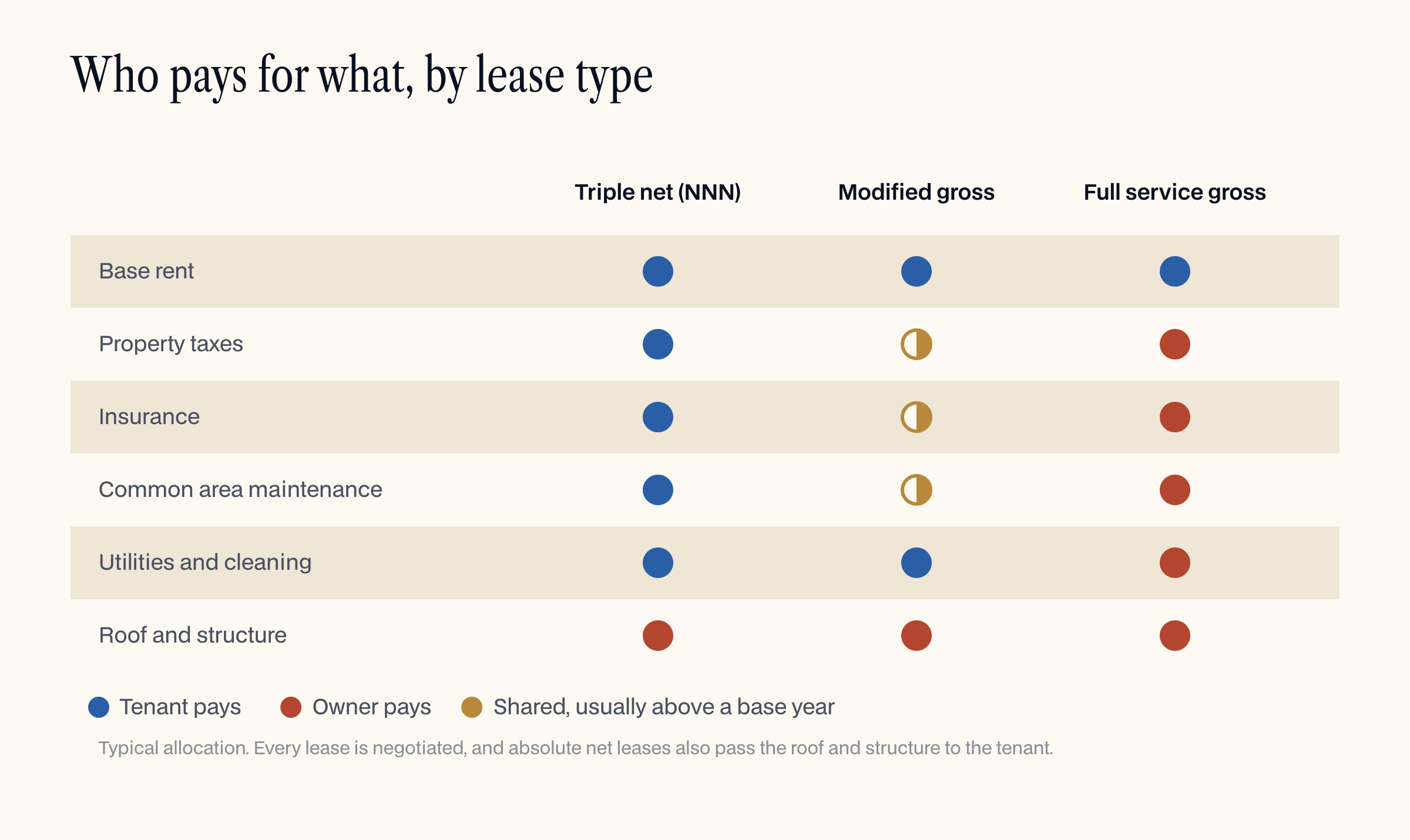
Triple net (NNN). The tenant pays base rent plus its share of property taxes, insurance and common area maintenance. The owner's income is close to the rent itself. Most Florida retail and industrial leases are written this way. Some leases go further and make the tenant responsible for the roof and structure too, which is often called absolute net.
Modified gross. The tenant pays a higher rent and the owner covers some or all operating costs, often with the tenant paying increases above a base year. Common in smaller office buildings.
Full service gross. The owner pays almost everything, including utilities and janitorial in many office buildings, and prices that into the rent. The owner carries the risk of rising costs.
When you compare two buildings, compare the leases before you compare the rents. A $30 per square foot NNN rent and a $45 full service rent can produce the same NOI, and a lease with fixed rent and no expense recovery can quietly erode your income every year that insurance and taxes rise.
The rent roll is the list of every tenant, the space they occupy, what they pay and when their lease ends. It is the single most important document in a commercial purchase, and it is where we spend most of our time before a client makes an offer. These are the questions we ask of every one.
Commercial lenders lend against the building's income first and the borrower's strength second. Two ratios decide how much they will lend.
Loan to value (LTV) is the loan divided by the property's appraised value. In today's market permanent lenders generally lend between 60% and 75% of value depending on the lender and the property, which means the buyer typically brings 25% to 40% in equity. Owner-occupied buildings can qualify for SBA 504 financing with as little as 10% down.
Debt service coverage ratio (DSCR) is NOI divided by the annual loan payments. Most lenders want at least 1.20 to 1.35 times coverage, so the building earns comfortably more than the loan costs. When interest rates are high, DSCR usually limits the loan before LTV does.
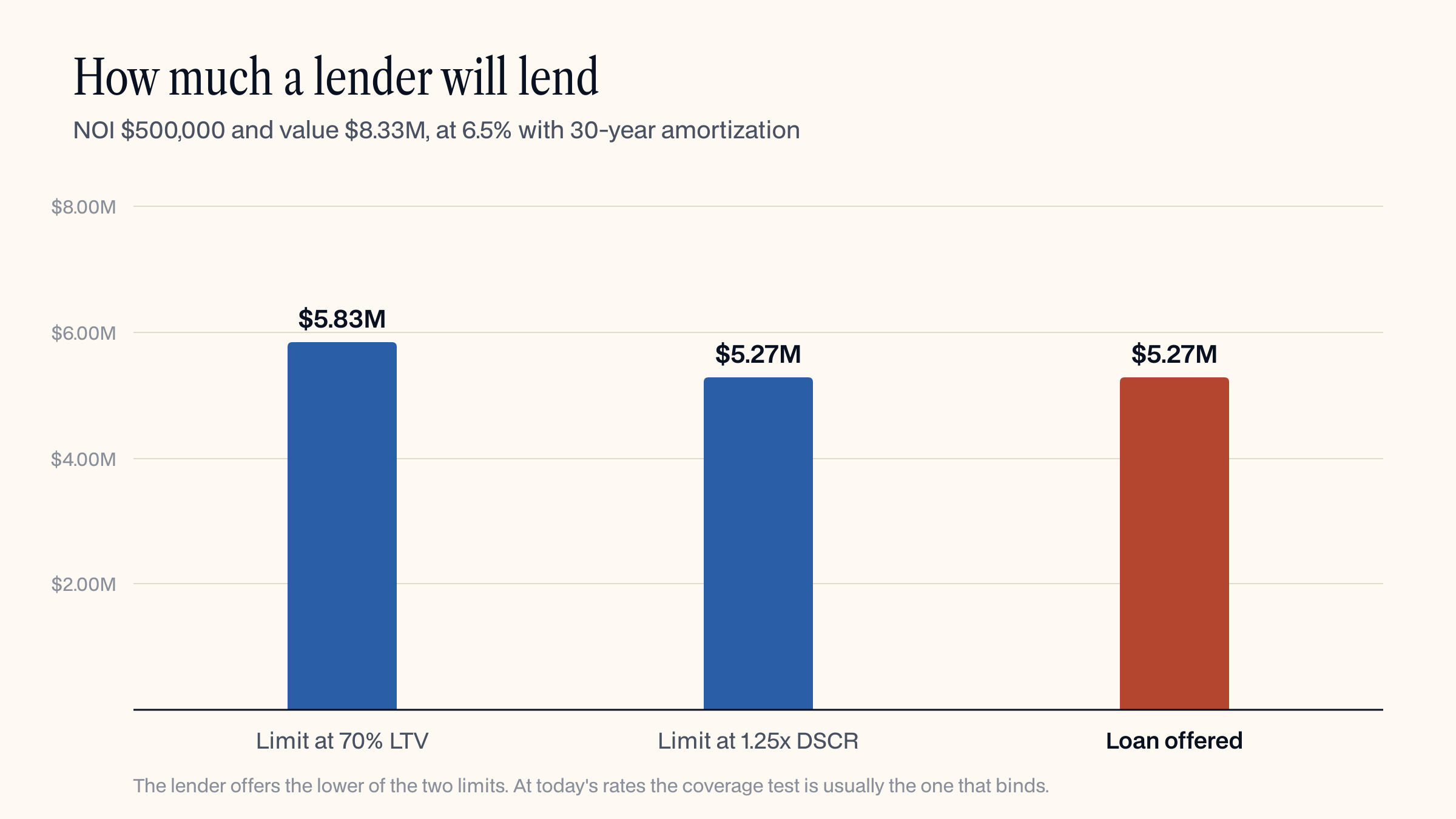
As of early November 2026, permanent commercial mortgage rates quoted by lenders and brokers ranged roughly from the high 5% to the low 8% range, with five, seven or ten year fixed terms and 25 to 30 year amortization. Your rate depends on the property, the leverage and the borrower. Buyers from outside the United States can borrow, but usually at lower leverage and with more documentation, and many prefer to buy with more equity and refinance later.
Florida has features that change the economics of ownership compared with other states. Some help, some cost, and a buyer should know all of them before pricing a deal.
Florida has no personal state income tax. For decades it was also the only state that charged sales tax on commercial rent, which tenants paid on top of their lease. That tax was repealed for rental periods beginning on or after October 1, 2025, so tenants now pay only the rent itself. For owners, this makes Florida space cheaper to occupy and easier to lease.
Commercial property in Florida is taxed on its assessed value. Until now, the assessed value of non-homestead property (commercial buildings, rentals, second homes) could rise by at most 10% a year for non-school taxes, until the property sells and is reassessed at market. On November 3, 2026, Florida voters approved Amendment 3 with about 62% of the vote. Among other changes, it lowers that cap to 5% a year beginning January 1, 2027. School taxes are still levied on full market value, and local governments may respond by raising millage rates, so the cap limits how fast the assessment grows, not the size of the bill.
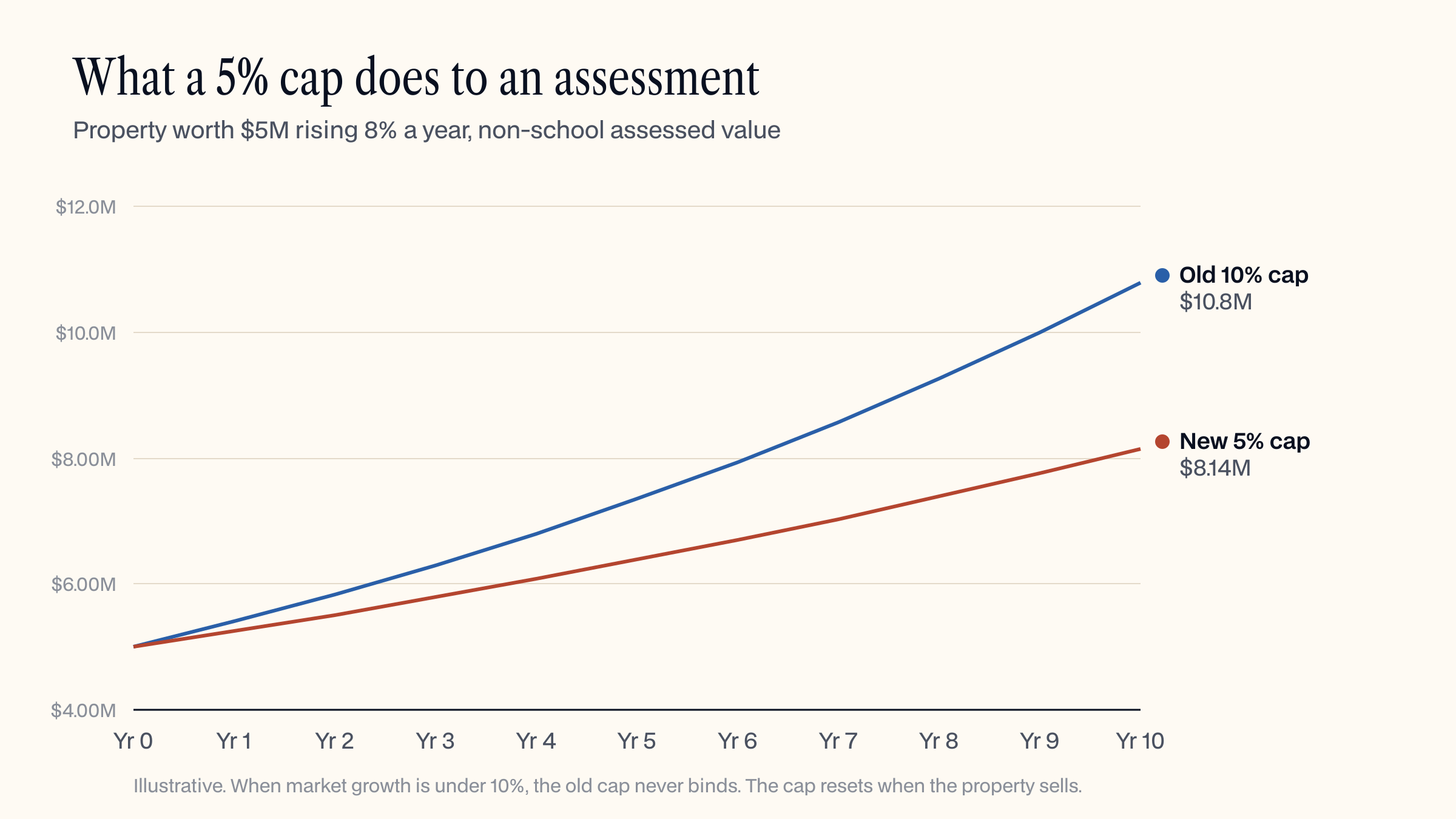
Two practical consequences matter for buyers. A building that has been owned for many years may carry an assessment well below market, and that gap disappears when you buy it, so underwrite taxes on your purchase price, not the seller's tax bill. And in a rising market, the lower cap makes your future tax costs more predictable once you own.
Florida charges a documentary stamp tax on deeds of $0.70 per $100 of price in every county except Miami-Dade. In Miami-Dade the rate is $0.60 per $100 plus a $0.45 surtax on anything other than a single-family home, so $1.05 per $100 on commercial property. If the purchase is financed, there is also $0.35 per $100 on the promissory note and an intangible tax of $2 per $1,000 on the mortgage. By custom the seller pays the deed stamps, but everything is negotiable.
| Example: $5,000,000 purchase with a $3,250,000 loan | Most Florida counties | Miami-Dade |
|---|---|---|
| Deed stamps (usually seller) | $35,000 | $52,500 |
| Note stamps (buyer) | $11,375 | $11,375 |
| Intangible tax on mortgage (buyer) | $6,500 | $6,500 |
Insurance has been the hardest cost to predict in Florida. After several difficult years, the market has eased: legislative reforms reduced litigation, new capacity entered the state, and commercial property rates have been falling through 2026. Even so, coverage still depends heavily on the building's age, roof, construction and distance from the coast. Named-storm deductibles of 2% to 10% of insured value are common, which means an owner should keep reserves to cover that deductible after a hurricane. We ask for a current insurance quote on every building before an offer is final, not after.
Florida's building code is among the strictest in the country for wind. Newer buildings and newer roofs are cheaper to insure and to finance. Check the FEMA flood zone, the age and type of the roof, and any open permits or code violations with the city before you are committed.
Most investors buy commercial property through a limited liability company rather than in their own name, to separate the property's liabilities from their other assets. Buyers who live outside the United States face additional questions about estate tax, withholding when they sell and how the income is reported. We cover those in our guides on opening a U.S. LLC and bank account from abroad and on U.S. estate tax for foreign nationals. The structure should be decided with a tax advisor before you sign, because changing it after closing can trigger a new transfer tax and a new property tax assessment.
Every property we bring to a client goes through the same short list.
If you are considering a commercial purchase in Florida, or want a second opinion on one you are already looking at, Valentina and our brokerage team at Infinity⁹ can walk through the numbers with you.
This guide is general information and is not legal, tax or investment advice. Market figures are from the sources cited and change every quarter. Valentina Ashrafi is a Florida-licensed real estate agent with LRF Group, a Berkshire Hathaway HomeServices affiliate.
Ahmad Ashrafi is Founder and CEO of Infinity⁹ in Miami and Chief Investment Officer of A9 Family Office. Since 2012 he has managed capital for Latin American families, today more than 75 families across 10 countries. He studied at Babson College, with specializations at Harvard in family office wealth management and at MIT in real estate investment, and is a member of the Forbes Finance Council.
Guides, conversations and the Quarterly Report, in your language. Nothing else.

Infinity⁹ is the commercial name of Infinity Investment Group LLC ("Infinity"), the parent holding company. Investment management is carried out by Infinity Capital Asset Management, LLC, an exempt reporting adviser (CRD 330526), for accredited international investors and high-net-worth individuals. Neither is a broker-dealer or a member of FINRA. Exempt reporting status does not imply a particular level of skill or training.
Past performance is not indicative of future results. Historical returns, expected returns and probability projections are speculative. All investment involves significant risk, including the possible total loss of capital. Infinity does not guarantee that investment objectives will be met.
Nothing here is an offer to sell or a solicitation of an offer to buy any security, nor investment, legal or tax advice. Any offering is made solely through definitive subscription documents under Regulation D of the Securities Act of 1933. Consult your own advisors.
Commercial brokerage operates through a licensed Florida agent with LRF Group at Berkshire Hathaway HomeServices, separately from investment management, under distinct regulatory oversight. Banking and custody are provided by partner institutions.