← Insights
Owning an Office Building in Florida, Including Medical Office
How office income works, why South Florida's office market has split in two, why medical office behaves differently, and what we check before buying.

How office income works, why South Florida's office market has split in two, why medical office behaves differently, and what we check before buying.
Office is the commercial property type with the most divided reputation. Across much of the United States, remote work left buildings half empty and values fell sharply. South Florida has gone the other way. Companies and wealthy founders relocating from New York, Chicago and California have filled the best buildings in Miami and Palm Beach, and rents in Brickell now exceed the average in Manhattan. Both stories are true at the same time, and an investor needs to know which one a particular building belongs to.
This guide covers how office income works, what is happening in South Florida's office market, why medical office behaves differently, and what we look at before a client buys an office building.
The office market is no longer one market. Buildings with modern space, good amenities and strong locations are leasing well and raising rents. Older buildings in weaker locations are competing on price and struggling to keep tenants. National data shows the same split: CBRE's mid-2026 cap rate survey found the widest disagreement among appraisers on the value of lower-quality office of any property type, while the best buildings held their value.
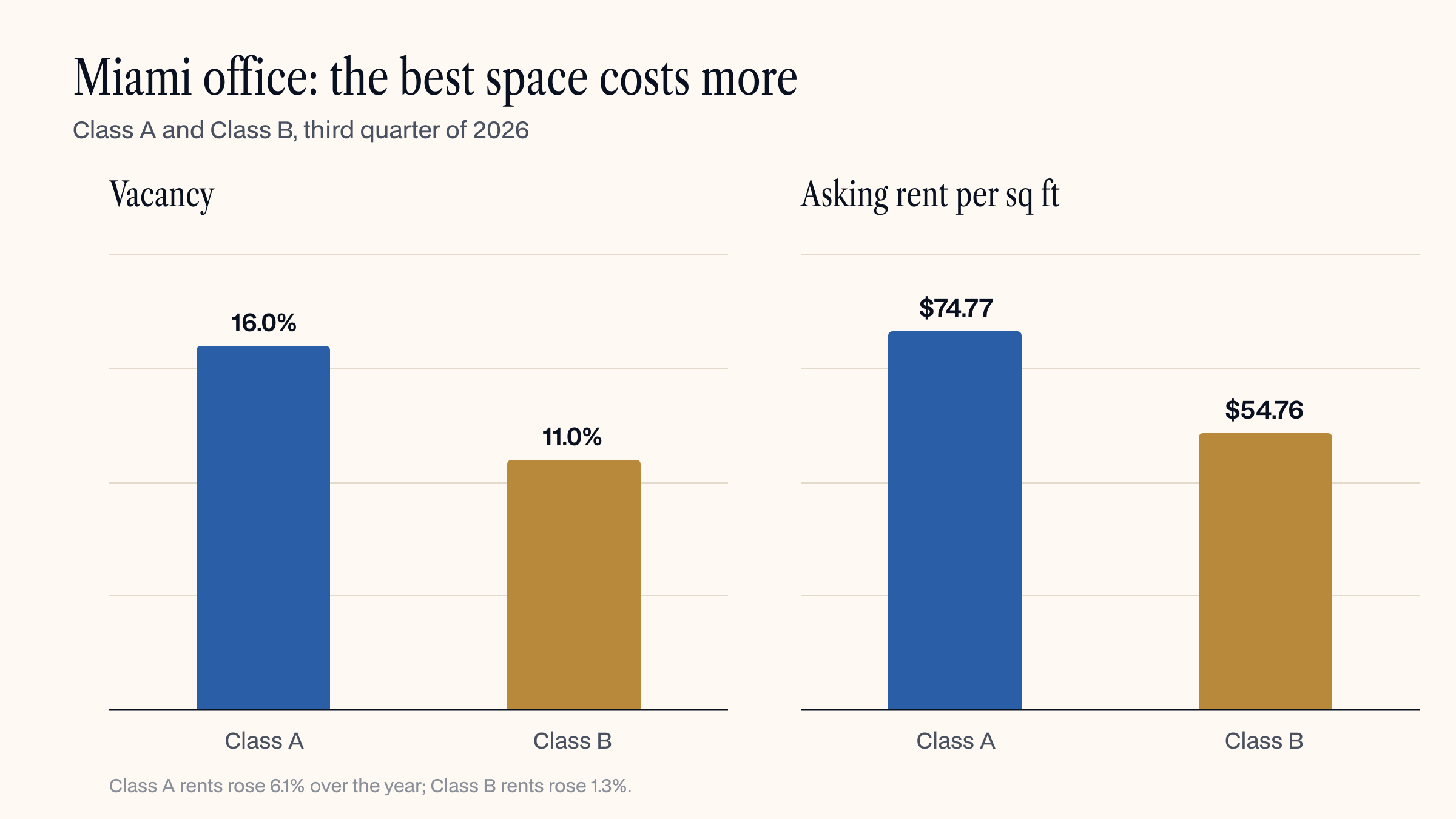
In Miami, Cushman & Wakefield reports that Class A vacancy fell to 16.0% in the third quarter of 2026 while Class A asking rents rose 6.1% to $74.77 per square foot. Class B buildings had lower vacancy, at 11.0%, but much slower rent growth of 1.3%, to $54.76. The best space is getting more expensive faster, even where more of it is available.
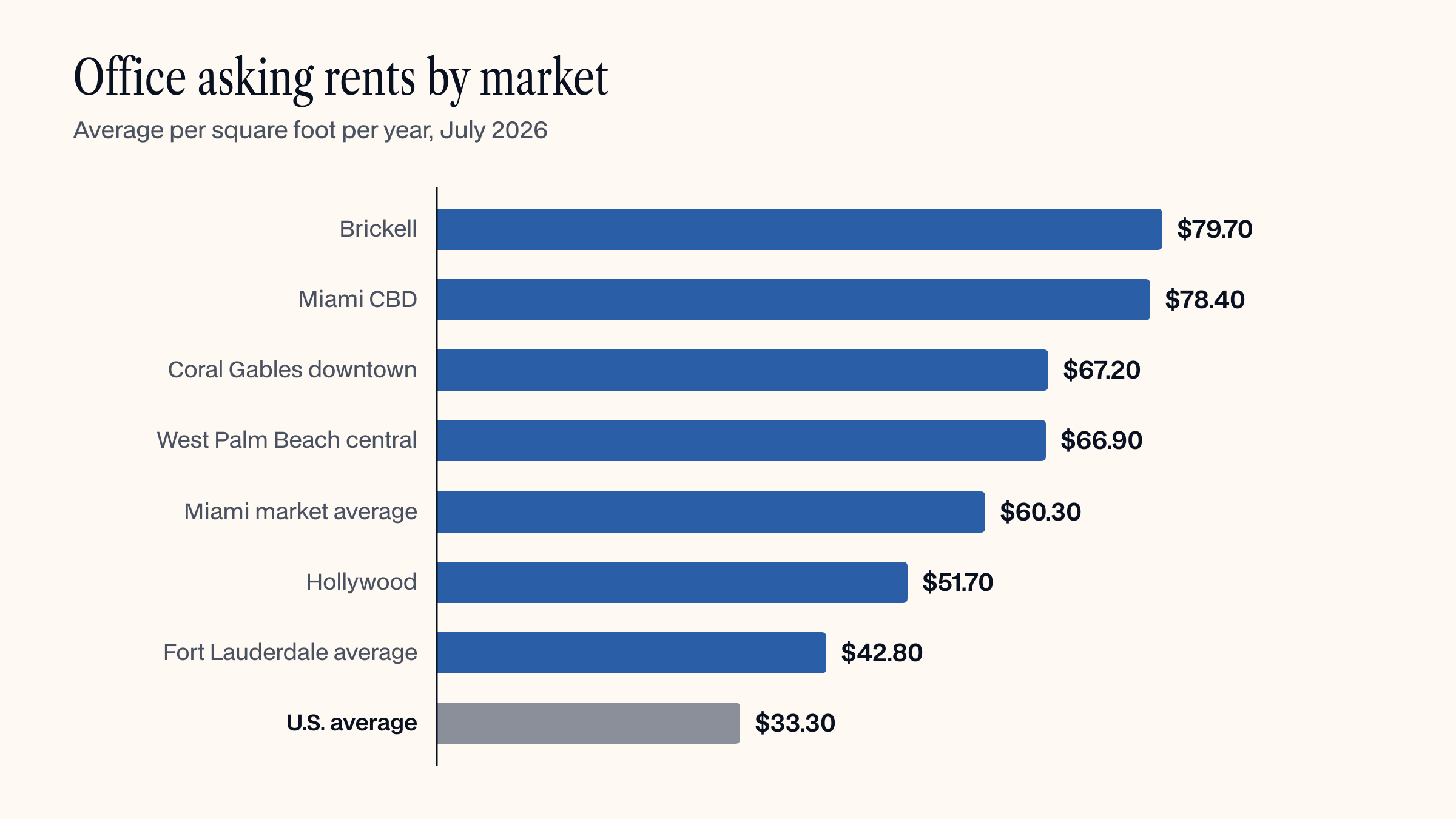
Office rents in South Florida vary more by submarket than by almost anything else. Yardi Matrix data compiled by MIAMI Realtors for July 2026 shows Brickell at about $79.7 per square foot and Miami's central business district at about $78.4, both above the Manhattan average. The broader Miami market averaged about $60.3, and the national average was about $33.3. Palm Beach has been growing fastest: the West Palm Beach to Boca Raton market led the nation's large markets in rent growth, up 19.9% over the year.
Office leases are more complex than retail or industrial leases, and the owner usually carries more cost and more risk.
Full service or modified gross rent. In most multi-tenant office buildings the rent includes operating costs. The owner pays taxes, insurance, utilities, cleaning and maintenance, and recovers increases above a base year from tenants. Rising costs that are not recovered come out of the owner's income.
Tenant improvements and leasing commissions. To sign a new office tenant, an owner usually pays to build out the space (tenant improvements, or TI) and pays brokerage commissions, and often gives several months of free rent. These costs can equal a year or more of rent on a five-year lease, and they recur every time a tenant leaves.
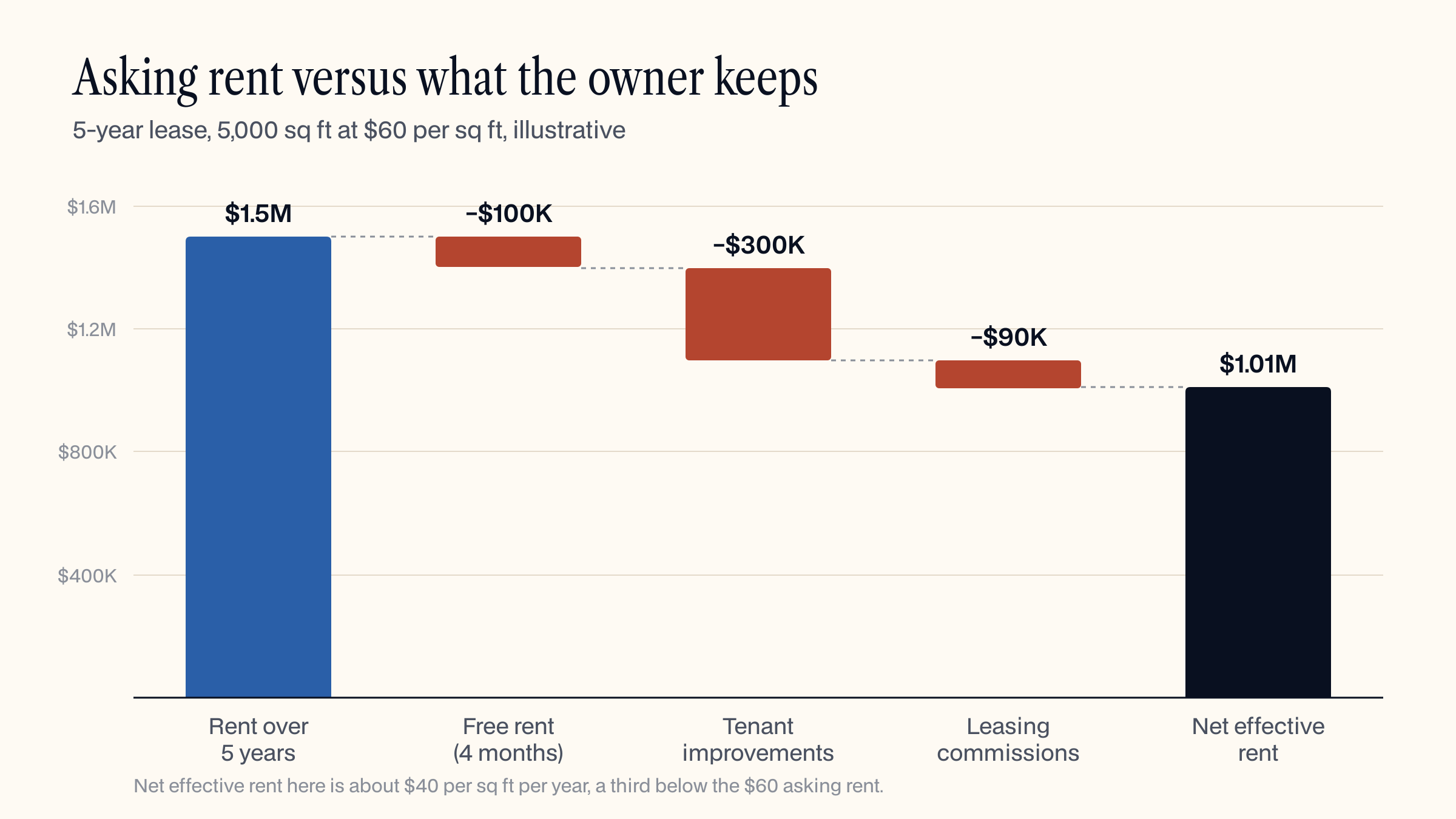
This is why the headline rent on an office lease can be misleading. What matters to an owner is the net effective rent: what is left from the lease after subtracting free rent, build-out and commissions, spread over its term. Two buildings asking the same rent can earn very different returns.
Medical office buildings (MOBs) house doctors, dentists, outpatient clinics, imaging centers and physical therapy practices. They have some of the most stable demand in commercial real estate, and Florida's growing and aging population adds to it every year.
For a private investor, a small, well-located medical office building leased to established practices or a health system can behave more like a net lease retail property than like a traditional office building.
| Area | What we look at |
|---|---|
| Building | Class, age, condition of elevators, HVAC and roof, parking ratio, amenities compared with competing buildings |
| Tenants | Who they are, how long they have been there, how much of the building each occupies, signs they are growing or shrinking |
| Leases | Expiration schedule, base years and expense recovery, renewal and termination options, free rent still owed |
| Costs to lease | Market tenant improvement allowances, commissions and free rent for the submarket |
| Market | Submarket vacancy, recent leases in competing buildings, new supply under construction |
| Exit | Who would buy the building in five to ten years and whether lenders will finance it |
Office can be a strong investment in South Florida, but it rewards owners who understand leasing and are prepared to spend money to keep a building competitive. For most private investors, we see the clearest opportunities in two places: well-located small medical office buildings, and smaller office buildings in strong submarkets where the price reflects a realistic cost of keeping them leased. The weakest buildings can look cheap on a cap rate and still be expensive to own.
For financing, taxes and the purchase process, see our complete guide to owning commercial real estate in Florida.
This guide is general information and is not legal, tax or investment advice. Market figures are from the sources cited and change every quarter. Valentina Ashrafi is a Florida-licensed real estate agent with LRF Group, a Berkshire Hathaway HomeServices affiliate.
Ahmad Ashrafi is Founder and CEO of Infinity⁹ in Miami and Chief Investment Officer of A9 Family Office. Since 2012 he has managed capital for Latin American families, today more than 75 families across 10 countries. He studied at Babson College, with specializations at Harvard in family office wealth management and at MIT in real estate investment, and is a member of the Forbes Finance Council.
Guides, conversations and the Quarterly Report, in your language. Nothing else.

Infinity⁹ is the commercial name of Infinity Investment Group LLC ("Infinity"), the parent holding company. Investment management is carried out by Infinity Capital Asset Management, LLC, an exempt reporting adviser (CRD 330526), for accredited international investors and high-net-worth individuals. Neither is a broker-dealer or a member of FINRA. Exempt reporting status does not imply a particular level of skill or training.
Past performance is not indicative of future results. Historical returns, expected returns and probability projections are speculative. All investment involves significant risk, including the possible total loss of capital. Infinity does not guarantee that investment objectives will be met.
Nothing here is an offer to sell or a solicitation of an offer to buy any security, nor investment, legal or tax advice. Any offering is made solely through definitive subscription documents under Regulation D of the Securities Act of 1933. Consult your own advisors.
Commercial brokerage operates through a licensed Florida agent with LRF Group at Berkshire Hathaway HomeServices, separately from investment management, under distinct regulatory oversight. Banking and custody are provided by partner institutions.