← Insights
Owning Industrial Property in Florida: Warehouses, Flex and Outdoor Storage
The kinds of industrial property in Florida, how the income works, where the market stands after a wave of new supply, and how we evaluate a building.

The kinds of industrial property in Florida, how the income works, where the market stands after a wave of new supply, and how we evaluate a building.
Industrial property is the part of commercial real estate most people never think about and depend on every day. Every package delivered to a home in Miami, every pallet of produce that comes through the port and every contractor's truck parked overnight sits, at some point, in an industrial building. For an owner, it is usually the simplest commercial property to run: few tenants, net leases, and buildings that are mostly a roof, four walls and a concrete floor.
This guide explains the kinds of industrial property you will find in Florida, how the income works, what the market looks like today after a wave of new construction, and how we evaluate a building before a client buys it.
"Industrial" covers buildings that look similar from the road and behave very differently as investments. Size and layout decide who the tenants are, and the tenants decide the risk.
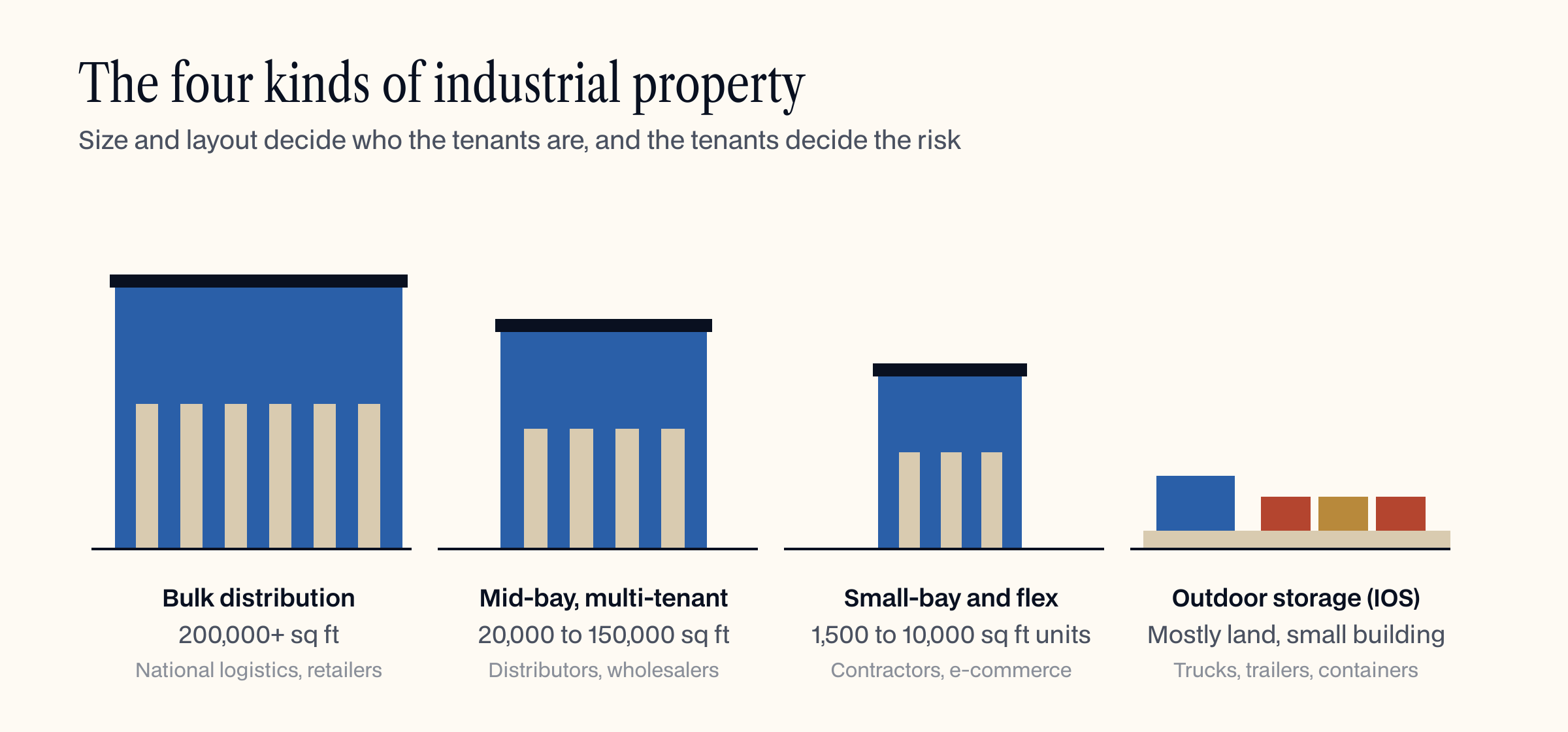
Bulk distribution. Large buildings, often 200,000 square feet or more, with high ceilings, many truck doors and deep truck courts. Tenants are national logistics companies and retailers. These are mostly institutional investments.
Mid-bay and multi-tenant warehouse. Buildings of roughly 20,000 to 150,000 square feet divided into units for regional distributors, wholesalers and light manufacturers. This is where much of South Florida's trade with Latin America is handled.
Small-bay and flex. Units of a few thousand square feet with a front office and a roll-up door at the back, leased to contractors, service companies, e-commerce sellers and small manufacturers. Many tenants, shorter leases, and in tight markets some of the strongest rent growth in the sector.
Industrial outdoor storage (IOS). Mostly land with a small building, used to park trucks, trailers, equipment and containers. Zoning for these uses is scarce near ports and highways, which is what gives these sites their value.
Industrial leases in Florida are almost always triple net. The tenant pays base rent and reimburses the owner for property taxes, insurance and maintenance of common areas. Leases commonly run three to ten years, with fixed annual increases. Because the buildings are simple, the owner's capital costs are mostly the roof, the parking and truck areas, and the cost of preparing a space for a new tenant.
Industrial is also unusually sensitive to the details of the building. Clear height (the usable height inside), the number and type of loading doors, truck court depth, power capacity and the amount of yard space all decide which tenants the building can serve. A building that does not meet modern tenants' needs can stay empty in a market where newer buildings fill quickly.
After record demand in 2021 and 2022, developers built a great deal of new space across Florida, and vacancy rose as it was delivered. In the third quarter of 2026, Colliers data reported by Florida Realtors showed vacancy in every one of seven major Florida markets above the national rate of 7.23%, though businesses occupied more space in six of the seven during the quarter.
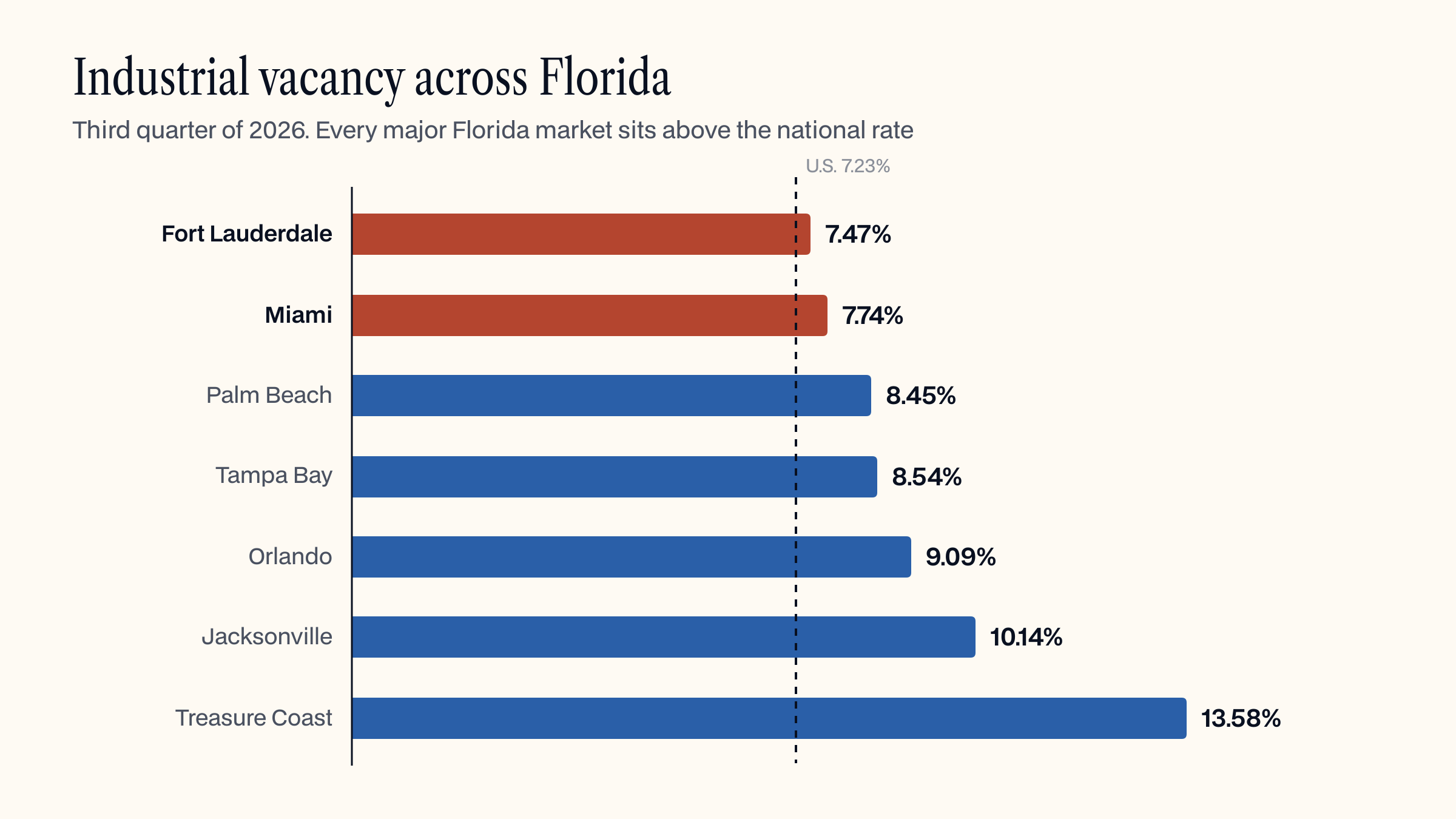
Within that picture, South Florida is the tightest part of the state. Miami and Fort Lauderdale have the least land available for new building, and the construction pipeline has slowed sharply: Cushman & Wakefield reports that Miami delivered about 220,000 square feet in the third quarter, down 71% from a year earlier, and recorded the lowest vacancy in Florida by its measure, at 5.6%. Lee & Associates reports that twelve-month net absorption across South Florida turned positive in the third quarter after more than a year of negative readings.
Rents have softened as new space competed for tenants. This is the kind of moment where buyers need to read market reports carefully, because different firms measure different things.
| Source, Miami industrial, Q3 2026 | Vacancy | Asking rent | Rent change over the year |
|---|---|---|---|
| Cushman & Wakefield | 5.6% | $15.16 per sq ft, net | Down 8.5% |
| CoStar via Matthews | 7.6% | $21.21 per sq ft | Up 1.4% |
Both are correct for what they measure. The firms define the market's boundaries, building sizes and rent basis differently. What matters for an owner is the rent that a tenant will actually sign for a building like yours, in your submarket, which is why we always look at recent leases nearby rather than a single headline number.
On pricing, CoStar data published by Matthews shows Miami industrial trading at an average cap rate of 5.53% and about $284 per square foot in the third quarter of 2026, both near the strongest levels the market has seen.
| Area | What we look at |
|---|---|
| Building | Clear height, loading doors (dock-high and grade-level), truck court depth, power, sprinklers, roof age |
| Site | Access to highways and the port, yard space, zoning and permitted outdoor storage |
| Tenants | Business type, financial strength, how long they have been in the building, how much they have invested in it |
| Leases | Term, annual increases, net lease structure, renewal options, who repairs the roof and structure |
| Market | Recent comparable leases, new buildings under construction nearby, vacancy in the submarket |
| Environment | Phase I environmental report, prior uses, flood zone and insurance quote |
One useful sign is how much a tenant has spent on its own space. A distributor that has installed racking, refrigeration or specialized equipment is much less likely to leave than one that simply stores boxes.
Industrial suits investors who want steady, net-leased income with little management and are comfortable that the value depends on a small number of tenants. In South Florida, where land is scarce and new supply is slowing, well-located small and mid-size buildings are, in our view, among the more durable commercial investments, provided the price reflects today's softer rents rather than the peak of 2022.
For financing, taxes and the purchase process, see our complete guide to owning commercial real estate in Florida.
This guide is general information and is not legal, tax or investment advice. Market figures are from the sources cited and change every quarter. Valentina Ashrafi is a Florida-licensed real estate agent with LRF Group, a Berkshire Hathaway HomeServices affiliate.
Ahmad Ashrafi is Founder and CEO of Infinity⁹ in Miami and Chief Investment Officer of A9 Family Office. Since 2012 he has managed capital for Latin American families, today more than 75 families across 10 countries. He studied at Babson College, with specializations at Harvard in family office wealth management and at MIT in real estate investment, and is a member of the Forbes Finance Council.
Guides, conversations and the Quarterly Report, in your language. Nothing else.

Infinity⁹ is the commercial name of Infinity Investment Group LLC ("Infinity"), the parent holding company. Investment management is carried out by Infinity Capital Asset Management, LLC, an exempt reporting adviser (CRD 330526), for accredited international investors and high-net-worth individuals. Neither is a broker-dealer or a member of FINRA. Exempt reporting status does not imply a particular level of skill or training.
Past performance is not indicative of future results. Historical returns, expected returns and probability projections are speculative. All investment involves significant risk, including the possible total loss of capital. Infinity does not guarantee that investment objectives will be met.
Nothing here is an offer to sell or a solicitation of an offer to buy any security, nor investment, legal or tax advice. Any offering is made solely through definitive subscription documents under Regulation D of the Securities Act of 1933. Consult your own advisors.
Commercial brokerage operates through a licensed Florida agent with LRF Group at Berkshire Hathaway HomeServices, separately from investment management, under distinct regulatory oversight. Banking and custody are provided by partner institutions.