← Insights
Owning an Apartment Building in Florida: A Guide for Investors
How apartment buildings of five units and up earn and spend money, where South Florida rents stand, the Florida rules owners need, and how we evaluate a building.

How apartment buildings of five units and up earn and spend money, where South Florida rents stand, the Florida rules owners need, and how we evaluate a building.
An apartment building is the commercial property closest to everyday life. The tenants are households, the product is a home, and demand rises with every family that moves to Florida. Once a building has five or more units, it is financed, valued and traded as commercial real estate rather than as a house, and the way an owner should think about it changes accordingly.
This guide explains how apartment buildings earn and spend money, what the South Florida rental market looks like today, the Florida rules that affect owners, and how we evaluate a building before a client buys.
A building with one to four units can be financed with a residential mortgage, based largely on the buyer's own income and credit. From five units up, lenders treat the building as a business. They lend against the building's net operating income, look at its occupancy history and expenses, and size the loan by how comfortably the income covers the payments. The value of the building follows the same logic: it is worth what its income is worth to the next buyer, at the cap rate the market is paying.
That is good news for an owner who manages well. Every dollar of expense saved or rent added increases the value of the building, in a way that is not true of a single home valued by comparison with the house next door.
South Florida's apartment market has absorbed a large wave of new buildings and is tightening again. Lee & Associates reports that tri-county vacancy fell from 6.7% to 6.0% over the twelve months to the third quarter of 2026, while average asking rent rose to $2,331 a month. In Miami specifically, CoStar data published by Matthews shows vacancy of 4.4%.
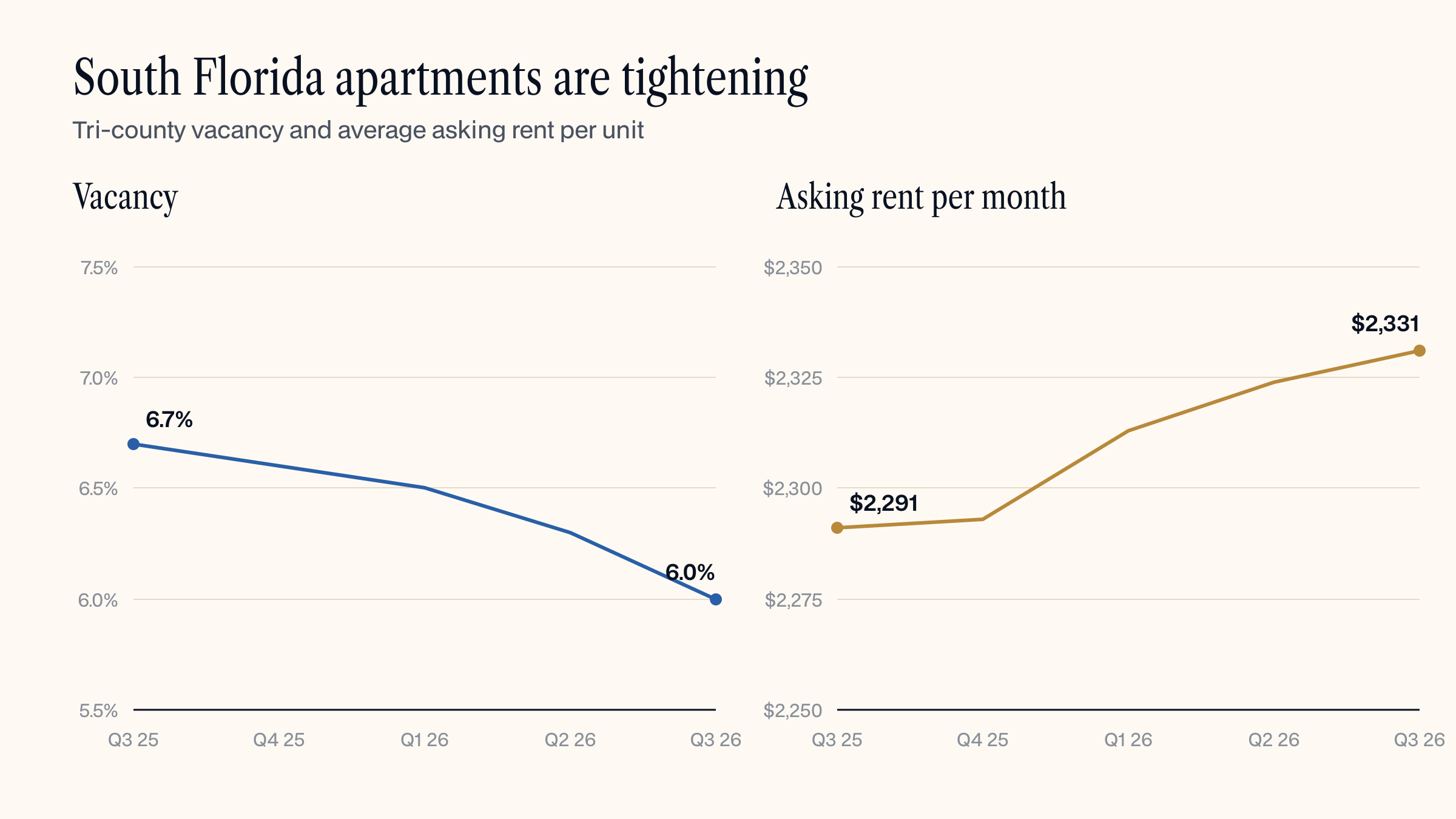
Rent growth has been modest after the surge of 2021 and 2022, and some newer buildings still offer concessions to fill units. On pricing, Miami apartments traded at an average cap rate of about 5.43% in the third quarter of 2026 according to the same CoStar data, a figure that has been rising slowly for several years as interest rates stayed higher. Higher cap rates mean lower prices for the same income, which is part of why investment activity has picked up.
Unlike retail or industrial leases, apartment leases are gross: the owner pays most of the building's costs, and those costs are a large share of the rent. That makes expense management as important as rent.
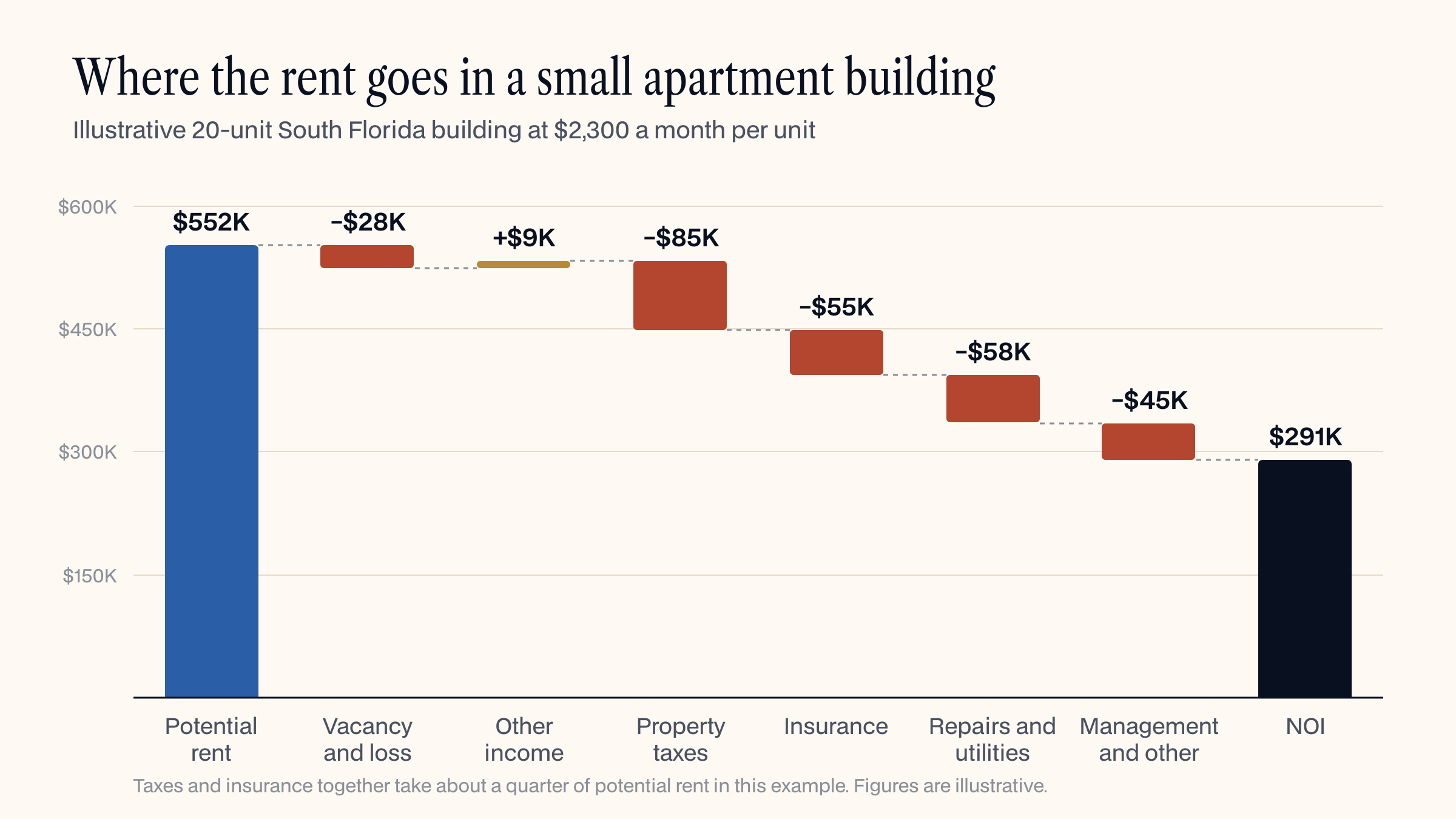
The chart above shows how the rent from a typical small South Florida building is spent before anything reaches the owner. It is a simplified example for discussion, and every building differs, but the order of magnitude is right: property taxes and insurance are usually the two largest costs, and together they can take a quarter or more of gross rent in Florida.
The main lines on an apartment operating statement are these.
Most private investors in apartments create value through one of a few strategies.
Apartments are the easiest commercial property type to finance. Fannie Mae and Freddie Mac lend on apartment buildings through approved lenders, and banks and life insurance companies compete for good loans. Agency lenders can go as high as 80% of value for strong properties, though most loans today are sized by the debt service coverage ratio rather than by value.
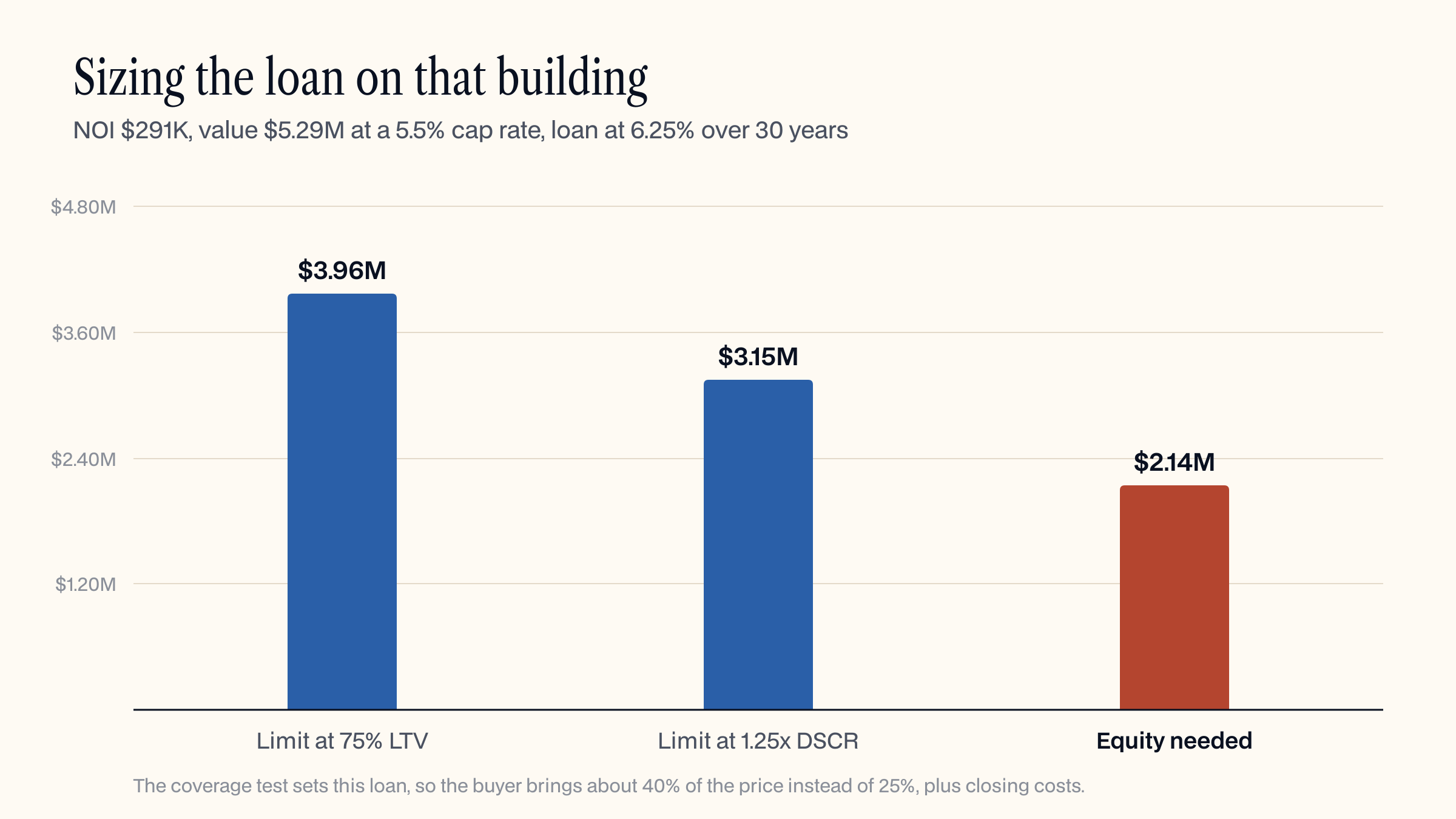
A lender that requires 1.25 times coverage will lend only an amount whose annual payments are no more than the building's NOI divided by 1.25. At today's interest rates that often produces a loan smaller than the maximum LTV would allow, so buyers should plan for the larger equity check. Buyers from outside the United States can finance apartment buildings, typically with more equity and documentation, and should speak with lenders early.
Property taxes. Apartment buildings are non-homestead property. Under Amendment 3, approved by Florida voters on November 3, 2026, the annual cap on increases in their assessed value for non-school taxes falls from 10% to 5% beginning in 2027. When you buy, the assessment resets toward your purchase price, so underwrite taxes on what you pay.
The Live Local Act. Florida's Live Local Act, updated again in 2026, lets qualifying developments with a large share of units affordable to households earning up to 120% of the area median income be approved administratively on commercial and industrial land, and offers a property tax exemption for qualifying affordable units in larger buildings, generally those with more than 70 such units. For owners of bigger buildings with moderate rents, the exemption can be significant; most small buildings will not qualify. Eligibility is technical and requires certification, so it should be reviewed with counsel before it is counted in a purchase price.
Insurance and building age. Insurers look closely at roof age, wiring, plumbing and wind mitigation features. A building with a new roof and impact windows can cost far less to insure than an older one next door. Coastal habitational properties still face the hardest insurance market, so get a quote before you commit.
Landlord-tenant law. Florida's landlord-tenant law is generally balanced and predictable for owners, and local governments are preempted from imposing rent control. Owners must still follow the rules on deposits, notices and evictions carefully, and should use a manager who knows them.
| Area | What we look at |
|---|---|
| Income | Rent roll against signed leases, rents compared with the neighborhood, concessions, collections history |
| Expenses | Two to three years of operating statements, and taxes and insurance re-estimated for a new owner |
| Building | Roof, plumbing, electrical, HVAC, windows, parking, flood zone, and any open permits or code cases |
| Units | Condition of every unit, not a sample; unit mix and sizes compared with what renters want |
| Location | Employment, schools, transit and new supply under construction within a short distance |
| Plan | What will be improved, at what cost, and the rent increase each improvement must earn |
Apartments suit investors who want an asset tied directly to Florida's population growth, are comfortable that it is an operating business, and value the fact that housing remains in demand in every economy. Bought at a sound price, with taxes and insurance underwritten honestly and a clear plan for the units, a small South Florida apartment building can be one of the most dependable ways to own commercial real estate.
For financing, taxes and the purchase process in more depth, see our complete guide to owning commercial real estate in Florida.
This guide is general information and is not legal, tax or investment advice. Market figures are from the sources cited and change every quarter. Valentina Ashrafi is a Florida-licensed real estate agent with LRF Group, a Berkshire Hathaway HomeServices affiliate.
Ahmad Ashrafi is Founder and CEO of Infinity⁹ in Miami and Chief Investment Officer of A9 Family Office. Since 2012 he has managed capital for Latin American families, today more than 75 families across 10 countries. He studied at Babson College, with specializations at Harvard in family office wealth management and at MIT in real estate investment, and is a member of the Forbes Finance Council.
Guides, conversations and the Quarterly Report, in your language. Nothing else.

Infinity⁹ is the commercial name of Infinity Investment Group LLC ("Infinity"), the parent holding company. Investment management is carried out by Infinity Capital Asset Management, LLC, an exempt reporting adviser (CRD 330526), for accredited international investors and high-net-worth individuals. Neither is a broker-dealer or a member of FINRA. Exempt reporting status does not imply a particular level of skill or training.
Past performance is not indicative of future results. Historical returns, expected returns and probability projections are speculative. All investment involves significant risk, including the possible total loss of capital. Infinity does not guarantee that investment objectives will be met.
Nothing here is an offer to sell or a solicitation of an offer to buy any security, nor investment, legal or tax advice. Any offering is made solely through definitive subscription documents under Regulation D of the Securities Act of 1933. Consult your own advisors.
Commercial brokerage operates through a licensed Florida agent with LRF Group at Berkshire Hathaway HomeServices, separately from investment management, under distinct regulatory oversight. Banking and custody are provided by partner institutions.